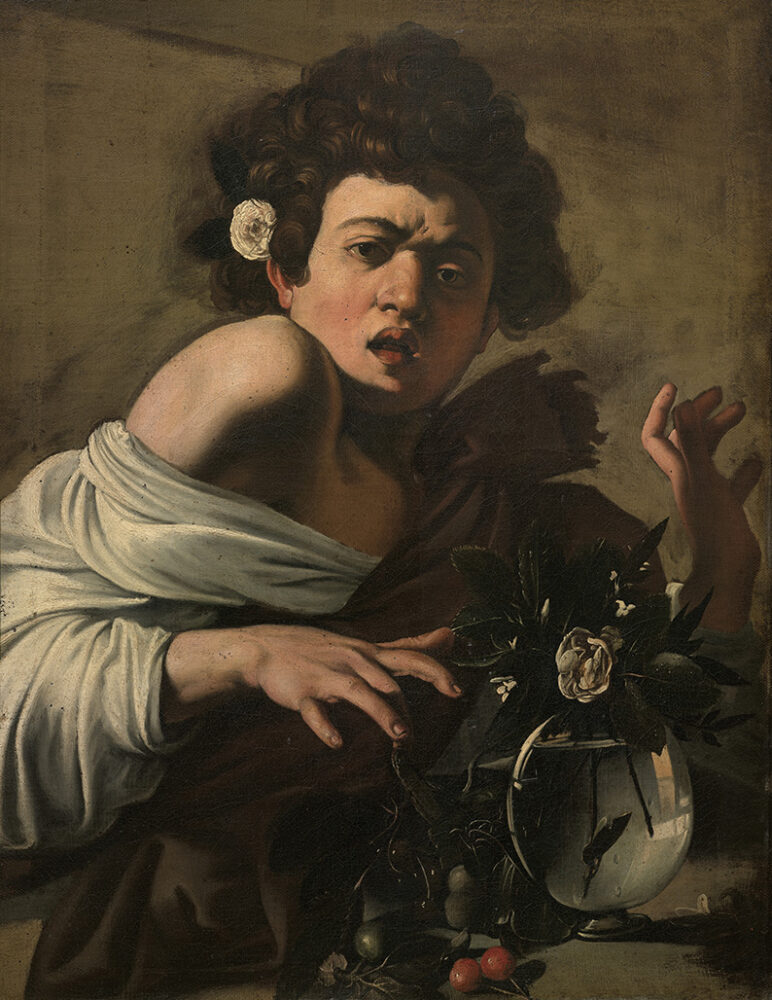
Michelangelo Merisi, known as Caravaggio (Italian, 1571–1610). Boy bitten by a lizard, circa 1597, oil on canvas. Florence, Fondazione di Studi di Storia dell’Arte Roberto Longhi.
Dark Matters: Caravaggio’s Light Still Burns
By Michael Solender
In fall 2022, while The Mint Museum president and CEO Todd Herman, PhD, was leading the members of the Mint’s Crown Society on a tour of the Venice Biennale and northern Italy’s artistic treasures, an unexpected opportunity arose.
It was during a rare free morning on the trip when Herman met with representatives of the Fondazione Roberto Longhi about staging an exhibition showcasing more than three dozen 16th and 17th century Baroque masterworks from their collection at the Mint.
Longhi, the late Italian art historian, scholar and curator was instrumental in shaping the contemporary understanding of early Renaissance and Baroque painting. His analysis and commentary are credited with elevating the works of Baroque masters, especially Caravaggio. Longhi’s impressive art collection, built over his lifetime, form the core holdings of the Fondazione Roberto Longhi in Florence.
The centerpiece of the show at the Mint would be a widely acclaimed Caravaggio, Boy bitten by a lizard (circa 1597), a striking and controversial portrait embodying the signature hallmarks of the artist’s transformational style.
Such an undertaking was met with careful pause and reflection. Museum attendance across the globe was down significantly due to the Covid pandemic. A Caravaggio featured exhibit would require considerable resources, yet, Herman was intrigued, and undeterred, because he saw a powerful through-line and sway from Caravaggio’s revolutionary style to artists across centuries, from Rembrandt and Matthias Stom to contemporary filmmakers Martin Scorsese, Isaac Julien and music videos from R.E.M. to Johnny Cash.
Caravaggio’s dramatic chiaroscuro and tight compositions of raw, street-worn models all feel strikingly modern and speak directly to today’s audiences. Layered atop this visual urgency is the extraordinary drama of Caravaggio’s own life—his volatile temper, notorious street fights, fluid sexuality, and even a murder charge. For Herman, the combination of groundbreaking artistic influence and
a life story that still crackles with relevance made the opportunity to bring the exhibition to the Mint simply too compelling to ignore.
“I thought with Caravaggio we’d have very contemporary, thought-provoking connections surrounding this work. We’d show how there is so much beyond what people think of when they think of Caravaggio,” says Herman.
Herman noted LGBTQ+ underpinnings in Caravaggio’s work and personal life, thoughts surrounding his intense realism, his interpretation of mythic and biblical themes, and controversial use of his street people (such as beggars and prostitutes) as models, were areas ripe for exploration. Even his legendary bad behavior all contributed to a discussion of how his work and influence have extended for centuries.
These elements are what make the exhibition fascinating, and what Herman hopes will resonate with audiences. “Does time, history, and context give us the ability to give grace where we wouldn’t necessarily today? These are questions and discussions museums should encourage,” he says.
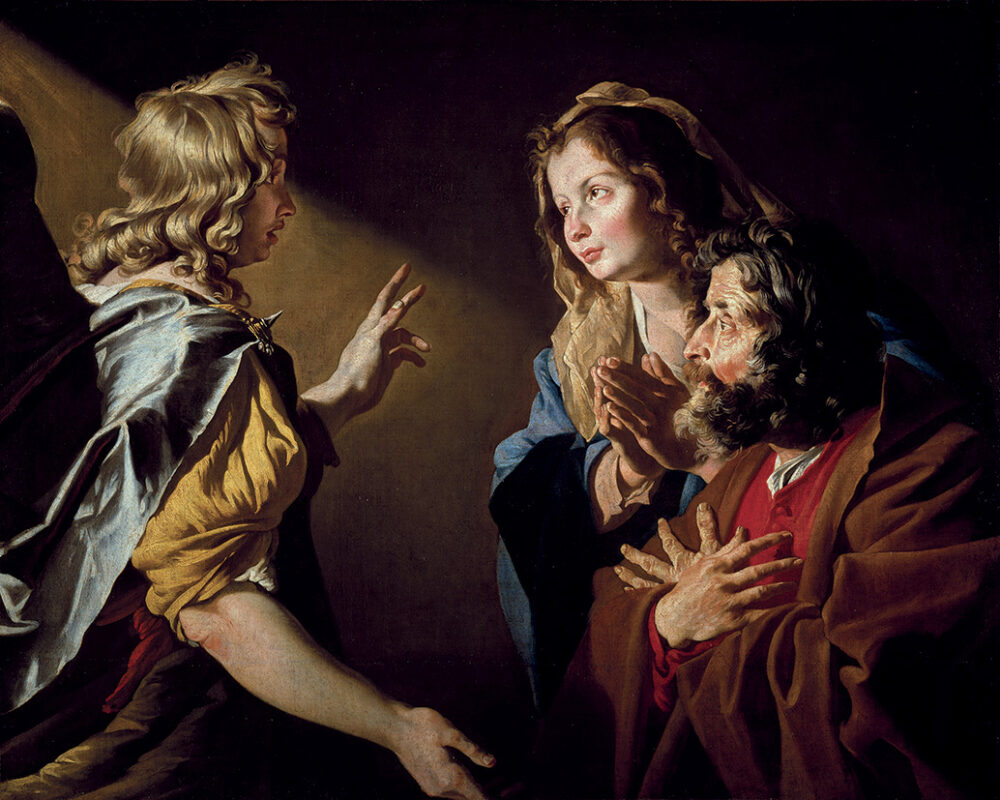
Matthias Stom or Stomer (Dutch, possibly Flemish, 1600–50). Annunciation of Samson’s birth, circa 1630–32, oil on canvas. Florence, Fondazione di Studi di Storia dell’Arte Roberto Longhi.
Cinematic immediacy
Caravaggio, born Michelangelo Merisi in 1571 near Milan, trained in Lombardy before moving to Rome in his early 20s, painting still lifes and portrait heads. As he matured, his style evolved into a cinematic immediacy and intense realism with scenes often framed like a live tableau that pulled viewers straight into the action. His use of bold contrasts of light and shadow, frequently spotlighted figures with a single raking light to heighten drama.
Patronized by Cardinal Francesco Maria del Monte for nearly five years, Caravaggio produced key works including The Musicians (circa 1595–96), Bacchus (circa 1596), and the Head of Medusa (1597), a striking ceremonial shield likely for the Medici.
His realistic and raw interpretations of biblical and mythical allegory choosing everyday street people—unwashed ruffians and even himself—as models led to consternation and controversy. The critiques only seemed to embolden Caravaggio and add to his legacy.
Caravaggio’s turbulent life—fights, arrests, and exile across Naples, Malta, and Sicily—didn’t stop him from creating gripping paintings exploring spiritual tension and raw human emotion. He died at 38, his artistic stature, cultural impact and influence only growing over time.
Caravaggisti
Nearly 35 works are on view in the exhibition, all hailing from the Roberto Longhi Foundation collection, including many by the Caravaggisti—artists who followed Caravaggio and echoed key elements of his style.
One striking example is The Annunciation of Samson’s Birth (circa 1630–32) by Dutch master Matthias Stom. A second-generation Utrecht Caravaggisti, Stom was taken with the style of Dutch painters who traveled to Rome in the early 1600s and absorbed Caravaggio’s bold, dramatic approach. This painting shows an angel appearing to Samson’s parents, illuminated by a single candle that heightens the contrast of light and shadow.
Even with Caravaggio’s brief life and lack of a workshop, his influence spread widely. Yet the classical tradition didn’t fade—artists working in a Raphael-inspired, polished style remained active well into the 17th century. As the church moved away from the ascetic teachings of Carlo Borromeo and Philipo Neri (both canonized), so the taste for Caravaggio’s reverence of the nobility of the poor in his paintings diminished.
“It is important people don’t leave thinking Caravaggio single-handedly redirected every Dutch, Italian, or French painter,” Herman says. “His impact was huge, but it existed alongside a strong and enduring classical current.”
Anchoring the exhibit is Caravaggio’s masterpiece, Boy bitten by a lizard. One of two nearly identical paintings, (the other is held by the National Gallery in London), the piece embodies essential Caravaggio elements and has led to controversial and contrasting analysis for centuries.
The beauty of the young bare shouldered boy, flower in his ear, for many displays homoerotic undertones. The lizard, barely seen at the bottom of the frame hiding amongst succulent fruit, is biting the boy’s middle finger. An allegory about the evil and pain of life’s excess such as illicit sex and overindulgence or a study in emotion and intensity? The painting lets the viewer decide.
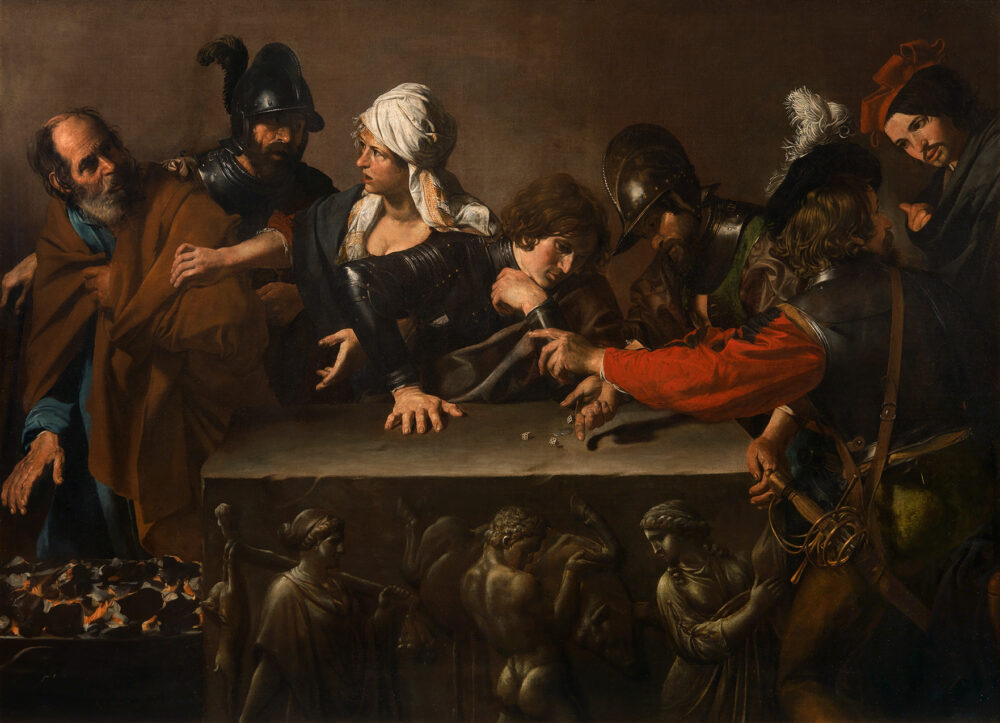
Valentin de Boulogne, known as Le Valentin (French, 1591–1632). Denial of St. Peter, 1615–17, oil on canvas. Florence, Fondazione di Studi di Storia dell’Arte Roberto Longhi.
Igniting a revolutionary spark
The exhibition’s subtitle, Revolution, is no accident. It opens the door to everything visitors are about to encounter.
“Revolution is not just the revolution of Caravaggio style,” explains Herman. “And not just the revolution of Roberto Longhi opening the doors to Italian Baroque art. But also, the revolution of Caravaggio’s creation of what some call modern day cinematography. To inspire videographers and photographers and filmmakers, is yet one more revolution that happens that Caravaggio helps to instigate.”
Museum goers visiting Caravaggio | Revolution will find clips, photos, and insights from artists like Scorsese, Julien, LaChapelle, and Hunter, plus music-videos from R.E.M. and Johnny Cash, juxtaposed against work by Baroque masters that lay bare how he still drives the way visual stories are told today.
“It’s not just the lighting, it’s the atmosphere,” Herman says. “There’s this sort of mystery that’s going on around the action. You can see the action, the action is highlighted, but there’s just this kind of pervasive mystery.”
For Herman, the exhibition is one that challenges the viewer on many levels. “The whole aspect of how we look at artist biography and context shape our perspective,” he says. “This exhibition nudges us to pause and ask: How should we interpret this now and why did people see it differently then?”
Caravaggio | Revolution: Baroque Masterpieces from the Roberto Longhi Foundation is generously presented by M.A. Rogers and Bank of America with additional support from the Samuel H. Kress Foundation. Individual sponsorship support for this exhibition is kindly provided by Betsy and Alfred Brand; Jane and Hugh McColl, Pat Rodgers, and Leigh-ann and Martin Sprock; Beverly and Jim Hance, Anna McKeithen Webersen, Laura McKeithen, Susan and Loy McKeithen, Marshelette and Milton Prime, and Rocky and Curtis Trenkelbach; Sarah and Tim Belk, Mary and Charles Bowman, and Jo Ann and Joddy Peer; Marty and Weston Andress, Mary Lou and Jim Babb, and Robin and Bill Branstrom. The Mint Museum is supported, in part, by the City of Charlotte and the North Carolina Arts Council.
Caravaggio | Revolution is organized by the Fondazione di Studi di Storia dell’Arte Roberto Longhi and Civita Mostre e Musei, in collaboration with The Mint Museum and the Museum of Fine Arts, St. Petersburg.
Michael J. Solender is a features writer who lives and works in his adopted home-town of Charlotte, North Carolina.